Commercial Waste Acton - Health and Safety Policy
Purpose and Scope
This Health and Safety policy sets out the approach for managing risks associated with commercial waste services in Acton and surrounding service areas. It applies to all personnel engaged in the collection, transport and handling of business refuse, including teams providing commercial rubbish Acton services, subcontractors and visitors to operational sites. The intent of this policy is to ensure safe working practices, protect employees and the public, and maintain reliable waste management Acton operations. The policy aims to be practical and proportionate, reflecting the everyday operational hazards of a rubbish collection Acton service without prescribing detailed legal commentary.Policy Statement
We commit to preventing work-related injury and ill health by implementing risk control measures, providing training and resources, and promoting a safety culture across all commercial waste Acton activities. Safety is a core business priority, and every employee has a part to play. The company will ensure that hazards are identified, assessed and eliminated or controlled so far as is reasonably practicable.
Responsibilities
The following roles and responsibilities apply to our commercial rubbish Acton operations:- Management: provide leadership, allocate resources and ensure compliance with this policy.
- Supervisors: implement safe systems of work, monitor performance and support training.
- Employees: follow safe work instructions, report hazards and use PPE correctly.
- Contractors: operate to agreed safety standards and cooperate with site rules.
Risk Assessment and Safe Systems
Risk assessments will be carried out for collection routes, depots, vehicle loading and transfer stations where commercial waste Acton services operate. Assessments consider manual handling, vehicle movements, slips/trips, exposure to hazardous substances and sharps, and interaction with the public in high footfall areas. Control measures include route planning, secure bin handling procedures, clear segregation instructions for recycling and general waste, and the use of mechanical aids.Training and Competence Personnel engaged in commercial waste collection, transfer and disposal will receive task-specific training. This includes induction training, vehicle operation, safe manual handling, hygiene and infection control, and hazardous materials awareness relevant to waste management Acton tasks. Training records will be maintained and refresher training scheduled to maintain competence.
Personal Protective Equipment (PPE) and Equipment
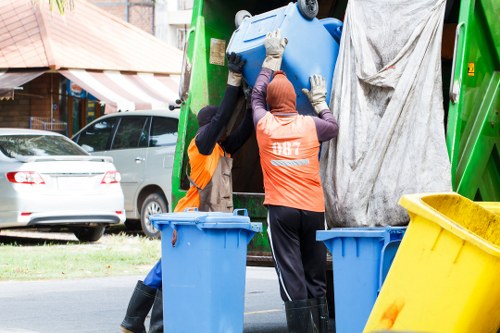
PPE, such as high-visibility clothing, gloves, safety boots and eye protection, will be provided where risk assessments indicate a need. Equipment maintenance schedules and pre-shift checks for vehicles and compactors are mandatory to reduce breakdown risks. The company will ensure that mechanical lifting aids and containment systems are used to reduce reliance on manual force, particularly when handling heavy or awkward loads during rubbish collection Acton operations.Site and Vehicle Safety
Vehicle safety procedures cover vehicle checks, secure loading, reversing controls and traffic management at depots and customer sites. Drivers must adhere to safe driving standards and avoid unsafe practices such as mobile phone use while driving. Where collections occur in busy commercial zones, specific controls are implemented to separate pedestrians from moving vehicles and to manage traffic flow during collection windows.
Hazardous Waste and Segregation
Segregation of hazardous or specialist wastes is essential for the safety of staff and downstream handlers. Procedures include identification, labelling and containment of hazardous materials, and clear exclusion of unauthorised mixing. Teams providing waste removal Acton services will be trained to recognise common hazardous items (e.g., batteries, chemicals, sharps) and to isolate and report them for specialist handling. Storage areas at depots are designed to minimise exposure and to control spill risks.
Incident Reporting and Emergency Response
All incidents, near misses and occupational illnesses arising during commercial waste Acton activities must be reported promptly. An established incident investigation process seeks root causes and corrective actions. Emergency response arrangements include first aid provision, spill kits, clear evacuation procedures and liaison with emergency services when required. First aiders and emergency coordinators are identified at each site and during mobile shifts.Monitoring, Audit and Performance
Safety performance will be monitored through routine inspections, safety audits, incident trend analysis and employee feedback channels. Key performance indicators cover near misses, lost-time incidents and completion of corrective actions. Regular toolbox talks and safety briefings will reinforce safe work methods and share lessons learned across the commercial rubbish Acton operation.Continuous Improvement This policy will be reviewed periodically and updated to reflect changes in operations, technology, or best practice for waste management Acton services. Suggested improvements from staff and supervisors are encouraged and will be considered through formal review cycles. The company aims for measurable reductions in incidents and ongoing improvements to safe working conditions.
Conclusion Compliance with this Health and Safety policy is mandatory for everyone involved in the provision of commercial refuse and waste collection services. By working together, maintaining vigilance and following the procedures set out here, the organisation will protect employees, customers and the public while delivering reliable and responsible commercial waste Acton services.
